2011年10月19日水曜日

Turing Machine

I read "BEYOND REASON".
I don't know about Turing Machine, but this is quite interesting because I can still find the similarity with web programing in these days. I also count prime numbers, so I can study from the algorithm of Turing Machine. The realm is completely different. However, it seems to be a new light for me.

Turing Machine is like an infinite tape. It read a sign from each cell.
For example, there are three cells, such as 0(zero),1,X.


0

1

X

A

0NA

1NA

XRB

B

0RB

1RB

0RC

C

XLD

XLD

XLD

D

0LD

1LD

XNE

E

Stop

Stop

Stop


This is like a dictionary or code.
0="Put 0 in the cell". 1="Put 1 in the cell". N="Don't move the cell". A="Stay in the same cell". X="Put X in the cell". R="Move the cell to the right". B="The new state". C="The end of the line.Then put X". L="Move the cell to the left". D="The new state". E="The end".

When you see A, there are three cells such as 0=(0NA), 1=(1NA), X=(XRB). 0NA means that put 0 in the cell and don't do anything. 1NA means that put 1 in the cell and don't do anything. XRB means that put X in the cell and move it to the right for a new state.
After you put X in a cell, you can go to B.
In B, there are 0=(0RB) 1=(1RB) X=(0RC).
You can adjust the same pattern from the dictionary, then you see that C means the end. However, you put X, so the line don't stop. It goes to C.
In C, it moves to the left which means the reverse.
Finally, you see the end in D,X=(XNE).
However, if you don't put XNE and you increase cells like D1,D2,D3・・・, Turing Machine may never stop for ever.
2011年8月4日木曜日

J function

When you see the golden key, π(x) would be related to zeros of Riemann's zeta function. J function is also based on π(x). Therefore, if you counted prime numbers, you would guess zeros of Riemann's zeta function.

ζ(s)=1/(1-1/2^s)×1/(1-1/3^s)×1/(1-1/5^s)×・・・

When s is 0.5+zi, ζ(s)=0.
Here is a Riemann's zero.
s=14.1435657,21.0279853,・・・

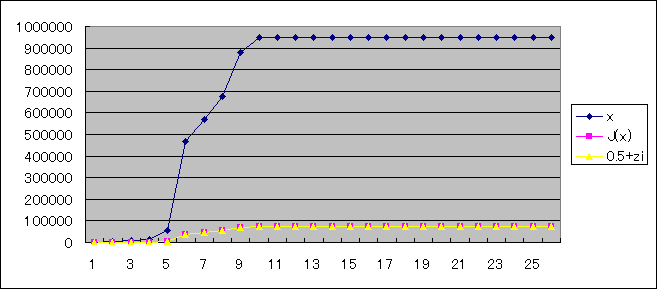
In order to use the calculator, you need to put an integer which must be close to 0.5+zi. It is very hard to guess it, because there would be no pattern about it. However, when you calculate J function, you would know that it is almost the same with 0.5+zi. Of course, this isn't perfect. J function is related to prime numbers. The pattern of prime numbers would be fractal, and I can calculate π(x). Therefore, as long as zeros of Riemann's zeta function is connected to π(x), it would move with the same pattern as inflation. I know that the calculation is complicated.

x→J(x)→0.5+zi
40→14.61667→14.1435657
65→21.5333→21.0279853
80→25.28333→25.01585333
105→30.5333→30.42810832
110→32.5333→32.93879514
137→37.5095→37.58932556
153→40.5095→40.92105478


Moreover, when you calculate π(45+10x), 0.5+zi is zeros of Riemann's zeta function and π(45+10x) is almost close to z. The differences between π(45+10x) and z are around 2000?.


2011年7月5日火曜日

Cantor set

I don't understand what infinity is, but Cantor set is almost similar with prime numbers and my blog.

At first, you get rid of the center of each block.


This is the infinite pattern, so I can also write this. You keep deleting the center.


F0=1
F1=1/3
F2=1/9
F3=1/27
・
・
・
F(x)=1/3^x


If x is infinite, F(x) may be Zero, but it isn't.
Imaginary lines may be real, if zero exists.
Basically, Cantor set is expressed by on and off, but zero would mean none duality of duality.


You always have the one block, and you take the center off.

Therefore, 0*3^∞ must be 1, and this is ridiculous.
Is this the philosophical problem?
I'm not so curious about it.


2011年5月1日日曜日

Fractal

I found the pattern of prime numbers, but I know that it is almost the same with sieve of Eratosthenes.

When you see odd numbers, there is symmetry and you can find sieve of Eratosthenes.


3

5

7

9

11

3

9

15

21

27

33

5

15

25

35

45

55

7

21

35

49

63

77

9

27

45

63

81

99

11

33

55

77

99

121

I mean x=(3,5,7,9,11) y=(3,5,7,9,11).
Therefore, you can see z=x*y and z=x+Σ2x or z=y+Σ2y. 9=3*3 and 9=3+2*3,15=3*5 and 15=3+4*3 or 15=5*3 and 15=5+2*5, 21=3*7 and 21=3+6*3 or 21=7*3 and 21=7+2*7・・・・.
z is not prime numbers, so x'=(3,5,7,11) y'=(3,5,7,11).

However, when you add 2, the symmetry is broken.


3

5

7

9

11

2

6

10

14

18

22

3

9

15

21

27

33

5

15

25

35

45

55

7

21

35

49

63

77

9

27

45

63

81

99

11

33

55

77

99

121

x=(3,5,7,9,11) y=(2,3,5,7,9,11) z=x*y and z=x+Σ2x or z=y+Σ2y
x' and y' are prime numbers. x'=(3,5,7,11) y'=(2,3,5,7,11)

Therefore,

when you can see z=x*y and z=x+Σ2x or z=y+Σ2y, z is not prime numbers.


This would be the infinite pattern.

2011年1月22日土曜日

The Golden Key

Riemann's zeta function is known as contraction.

This is also contraction.

Then you can get the golden key.

Zeros of Riemann's zeta function is related to π(x).

Therefore, if you can know the golden key, you may understand zeros of Riemann's zeta function.

As long as I use PC to count prime numbers, it seems to be the same with J(x). This is assumption. I know what I don't know.

2011年1月17日月曜日

A part is everything

It is very difficult to see what Riemann's zeta function is. I don't write about 0 and I can't understand it. However, it is connected with prime numbers.

Now I got this formula.
logζ(s)=1/2^s+(1/2*1/2^2s)+(1/3*1/2^3s)+・・+1/3^s+(1/2*1/3^2s)+(1/3*1/3^3s)+・・1/5^s+(1/2*1/5^2s)+(1/3*1/5^3s)+・・・

Then, you pick up (1/2*1/3^2s) from it. I don't know the reason, but I follow Prime obsession.


I can't understand this process, but this leads to J function


You may see a form which is almost a rectangular (width="3^2→∞", height="1/2").
J(x) include ∞, and 1/2*s*∫[3^2→∞]x^(-s-1)dx is also ∞.
Is this like a black hole?


2011年1月16日日曜日

Riemann's zeta function

Riemann's zeta function is expressed like this. This depends on Sieve of Eratosthenes.


According to index principle,

log1/A=-logA,so

Isaac Newton found

x=1/p^s (p is prime)


∴

This pattern is really complicated and miraculous. I'm in the spiral road.
Then, you need infinitesimal calculus.

I referred to Prime obsession.

A Geometric Visualization of Riemann Zeros Through Circular Dynamics

A Vector-Field Interpretation of \(Li(x^\rho)\) Abstract Assuming the Riemann Hypothesis, every nontrivial zero of the Riemann z...